
Antioco il Moro Tre: boat trips in southern Sardinia, between Carloforte, Calasetta and Sant'Antioco.
Updated: Oct 7

In the port of Calasetta, early in the morning, the air carries the familiar smells of salt and wet wood. The silence is broken only by the gentle movement of the boats at the dock and by the small daily gestures of a few fishermen mending their still-damp nets, untangling the knots with expert hands.
Among the weathered fishing boats and new pleasure craft, one gozzo stands out, its solid bow rising cleanly above the water. Its simple yet elegant lines recall the boats used until the mid-twentieth century for coastal trading and fishing along the shores of the western Mediterranean.
The hull, with its traditional lines, is painted a brilliant aqua green on its lower section, while the upper part, in smooth, warm light wood, adds a personal, artisanal touch. The deck is made of iroko, a noble wood particularly resistant to salt water and weathering.

On the hull, a name written in italics stands out — "Antioco il Moro Tre" — a detail that hints to those who know Latin sail at a long history of sea and competition: it is the third in a famous series of racing boats bearing the name of the celebrated Christian saint Antioco of Sulcis, which along the coasts of Sardinia have proudly defended the name of the Dessì boatyard of Sant'Antioco.

Here are some articles about the first Antioco il Moro I, winner of the Trofeo Presidente della Repubblica and Andrea Mura's account.
The history of Antioco il Moro Tre
Built in the early nineties at the boatyards of Sant'Antioco, the gozzo was designed and built by master carpenter Nino Dessì as his personal boat for sailing and competing in regattas, at a time when Latin sail was still very widespread along the coasts of Sardinia.
Nino Dessì was a true master of wood and sea. He had learned his trade at the yard through concrete, time-acquired knowledge: choosing the wood, working it, gradually shaping it without relying on rigid models, but trusting in observation and expert craftsmanship.
Dessì himself recounted this in a testimony preserved at the Sardinia Digital Library, from which emerges a trade based above all on daily practice and the direct transmission of know-how. With the introduction of fibreglass and industrial techniques, this way of building gradually lost ground, replaced by faster and cheaper processes, but also more distant from the craftsman's direct relationship with materials.
In boats like the Moro, that knowledge remains visible today in the lines, the hand-worked wood and the details.
The Latin sail in the Mediterranean and in Sardinia
The Latin sail is one of the oldest rigs in the Mediterranean, characterised by a triangular sail attached to a long yard inclined on the mast. For centuries it was used in coastal navigation and fishing, thanks to its effectiveness in variable winds.
In Sardinia this type of rig continued to be used longer than in other areas of the Mediterranean. Until the mid-twentieth century it was typical of working boats and, subsequently, with the decline of traditional activities, many vessels were recovered and restored, returning to sea above all on important occasions such as the Trofeo Presidente della Repubblica.
Events such as the Stintino regattas continue to keep this tradition alive, as do those in other locations in Sardinia: Carloforte, Sant'Antioco, Alghero, Porto Torres, Cagliari, Oristano, Bosa and La Maddalena. These are not only genuine competitions, but also occasions to come together and keep the culture of Latin sail alive.
Why choose a boat like Antioco il Moro Tre
Each of our trips is an exclusive small cruise along the magnificent coasts of southern Sardinia, designed to give our eight guests direct contact with the sea. On board you find, in comfort and safety, the authentic flavour of a journeythat only a wooden Latin sail boat can offer. We sail slowly, touching beaches, cliffs and caves. We pass beneath lighthouses and ancient mining ruins, stopping to explore with mask and snorkel the crystal-clear waters of Carloforte, Calasetta and Sant'Antioco. The captain treats us to a typical aperitif and an unforgettable lunch.
FAQ – Frequently asked questions about trips with Antioco il Moro Tre
Where do the boat trips to Carloforte depart from?
Trips depart from the port of Calasetta. It is also possible to board from the port of Carloforte, with times agreed at the time of booking.
How many people can board Antioco il Moro Tre?
The boat accommodates a maximum of 8 guests, to guarantee an intimate experience in direct contact with the sea and nature of the Sulcis archipelago.
Are the boat trips to Carloforte suitable for children?
Yes, from age 5. Children between 5 and 10 years old have a reduced price. The captain and crew guarantee maximum safety on board.
What is the best time for a boat trip in the Sulcis?
From June to October, with calm seas and stable weather conditions. August is very popular: early booking is recommended. September and October offer more exclusive outings.
How can I book a boat trip?
Would you like to discover the sea of southern Sardinia on board a historic Latin sail boat? Contact Captain Gianluca to book your tour of the Sulcis. Full day, half day or private trip: we will find the perfect option for you. Call us, message on WhatsApp or send an email — we are ready to show you the most beautiful sea in southern Sardinia.
Full day boat trip to Carloforte.
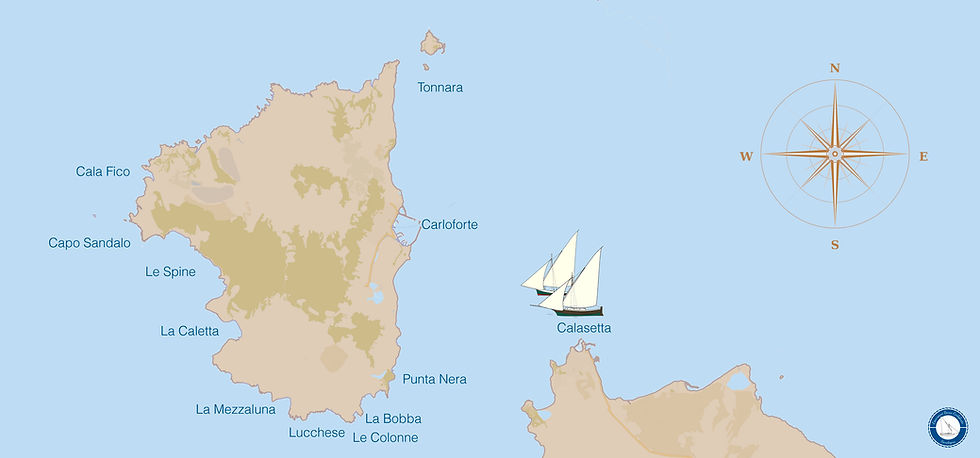
The full day is the most complete tour: we set sail from the port of Calasetta, visit the seafront of the Tabarchin village, sail towards the Colonne and the beaches of Punta Nera and La Bobba. Before lunch, a snorkelling stop at the Le Spine reef, with breathtaking seabeds. In the afternoon, course set for the Capo Sandalo lighthouse and the wild cove of Cala Fico. Visit the full trip page for all the information.

Half day boat trip to San Pietro and Sant'Antioco with aperitif.
For those who want a shorter boat trip in the Sulcis, the half-day trip offers two snorkelling stops and a typical aperitif on board. Several itineraries are available, chosen by the captain based on weather conditions and guests' preferences. Visit the full page for all the details.
